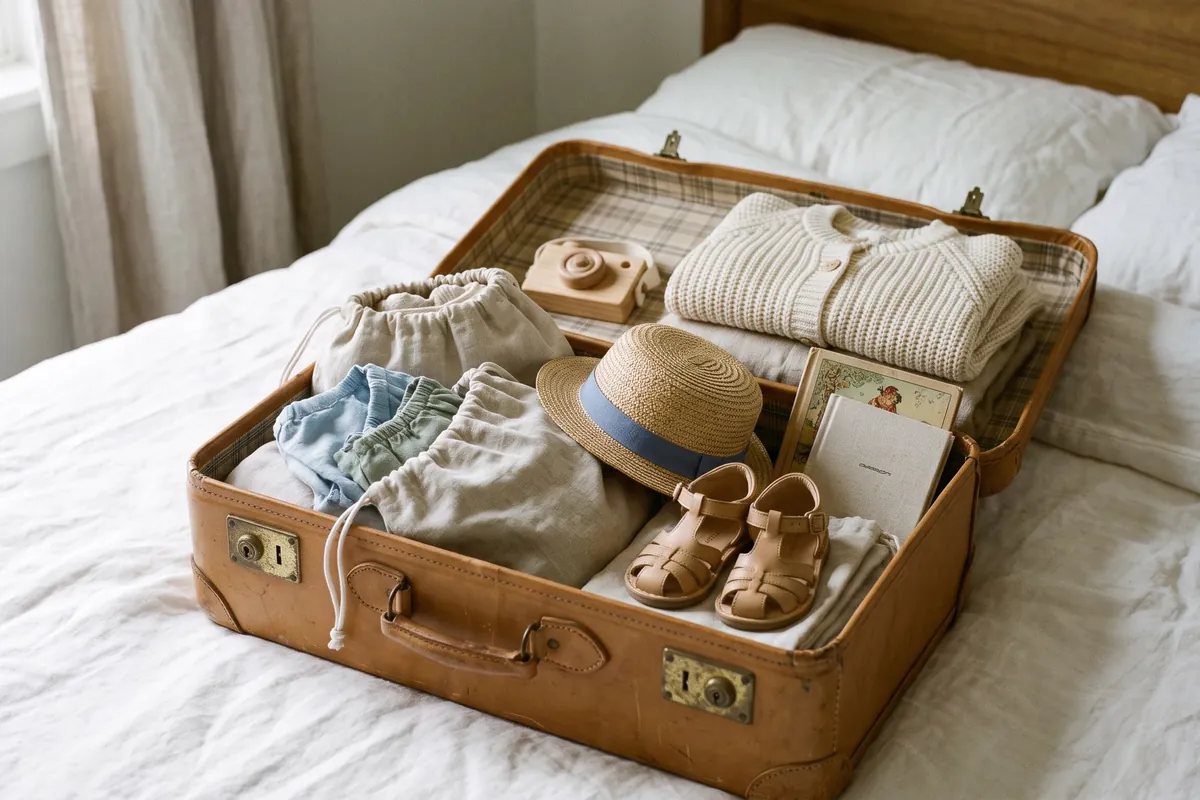

Packing for children, a calm system for family trips
Lists, outfits, layers, cabin bags and documents: a simple method for packing for babies and children that keeps the day of departure calm.
The day of departure has a reputation for chaos, and much of it begins the night before, with an open suitcase and no plan. Packing for children does not need to be stressful. A few fixed habits, repeated on every trip, turn it into a quiet routine: one list per child, outfits planned by the day, instead of bulk, a well-stocked and documents checked well ahead. Here is the system, step by step.
Begin with a list, not a suitcase
Calm packing starts at a desk. Write one list per child, divided into clothes, sleep, washing, health, documents and activities, and keep it from trip to trip. Each time you travel, you only adjust it for the climate, the length of the stay and your child’s age.
- Note the number of nights and whether laundry will be possible
- Plan one outfit per day for each child
- Add spare outfits according to age
- Choose layers for the climate rather than bulky pieces
- Pack the cabin bag and the separately, and check both last
Tick items off as they go into the case, not as you think of them. It sounds pedantic, yet it is the simplest way to avoid that moment in the hotel room when a single essential turns out to be missing.
Tick items off as they go into the case, not as you think of them.
Outfits, spares and layers
Planning outfits per day sounds like a lot of effort, but it saves space and decisions. Lay out each day’s clothes, check that they work together, then fold them as a set. Children can often help with this, which also makes them more willing to wear what has been packed.
Babies and toddlers get through clothes quickly, which is why one spare outfit per child per day is a sensible measure. For older children a spare every two or three days is usually enough, provided you can do some laundry along the way.
Layers work better than bulky items. A cardigan, a light jacket and a sun hat cover most climates, from a cool morning at the airport to a warm afternoon by the sea, and they take up a fraction of the room of a thick coat. Choose pieces in colours that go together, so that every top works with every pair of trousers.
Cubes, pouches and a place for everything
Once the clothes are chosen, the question is how to keep them in order. Packing cubes or linen pouches, one per child or one per category, make it easy to find things in a hotel room without emptying the whole suitcase onto the bed. Some families give each child a colour, while others prefer one pouch for underwear and socks, one for swimwear and one for sleep.
Whichever method you choose, keep it the same on every trip. Children soon learn where their things live, and older children can unpack and repack their own cube, which gives them a small and welcome sense of responsibility.
The cabin bag
The cabin bag is where good planning shows. It should cover the journey itself and a possible delay, without becoming a second suitcase.
- A change of clothes for each child, and a clean top for the parent
- Nappies and wipes
- Any medicines your child needs
- Snacks and a water bottle
- A small comfort toy
- A few quiet activities
Liquids in hand luggage are limited at many airports. Baby milk and baby food needed for the journey are usually allowed in larger quantities, but the rules are not the same everywhere, so check the rules of your departure airport before you travel. If your child takes regular medicine, ask your paediatrician or pharmacist how best to carry it.
Documents for every child
Documents deserve attention weeks, not hours, before departure. In the European Union every child needs their own passport or identity card for travel abroad, and that includes babies. Entries of children in a parent’s passport are no longer valid, so an older passport with a child’s name in it is not enough.
Check the expiry date of every passport and identity card in the family as soon as you plan the trip, and look up the entry requirements of your destination as well. Keep all documents together in one folder in the cabin bag, never in the suitcase.
The first night bag
The last element of the system is small but effective. Pack a separate first night bag with pyjamas, toothbrushes and the comfort toy, so you do not need to unpack everything on arrival. After a long journey, a late check-in and tired children, being able to open one small bag and begin the bedtime routine at once makes a real difference.
Unpacking can then wait until the morning, when everyone is rested. With the cubes in place, it takes minutes rather than an hour.
Glossary
- Packing cube
- A soft, zipped fabric case used to sort clothes inside a suitcase by person or by category.
- Cabin bag
- The bag you keep with you on board, holding what the journey itself requires.
- First night bag
- A small, separate bag with pyjamas, toothbrushes and the comfort toy, opened first on arrival.
- Layers
- Light pieces worn one over another and added or removed as the temperature changes.
Questions and answers
Can I take baby milk through airport security?
Liquids in hand luggage are limited at many airports, but baby milk and baby food needed for the journey are usually allowed in larger quantities. The rules are not the same everywhere, so check the rules of your departure airport before you travel, and ask your airline if anything is unclear. Pack these items where you can reach them easily during the journey.
Does a baby need their own passport?
In the European Union, yes. Every child needs their own passport or identity card for travel abroad, and entries of children in a parent’s passport are no longer valid. Apply well ahead of the trip, as issuing a document can take time, and check the entry requirements of your destination before you book.
How many clothes do older children need?
Plan one outfit per day and add a spare every two or three days, which is usually enough if laundry is possible during the stay. Without laundry, pack a little more. Layers help: a cardigan, a light jacket and a sun hat cover most climates and combine with almost everything in the case. Older children can also help to choose and fold their own outfits.