
Baby and children’s clothing sizes, explained
Centimetres, months, years and T sizes: how the European, British, French and American systems work, how they relate to growth and how to choose well.
A size 68 bodysuit from one country, a 6 to 9 months cardigan from another, a 3T jacket from a third: buying for babies and children soon becomes a lesson in different systems. They are less confusing than they look. Once you know what each label measures, and how quickly children grow, you can choose with confidence, for your own child or as a gift.
Continental Europe: sizes in centimetres
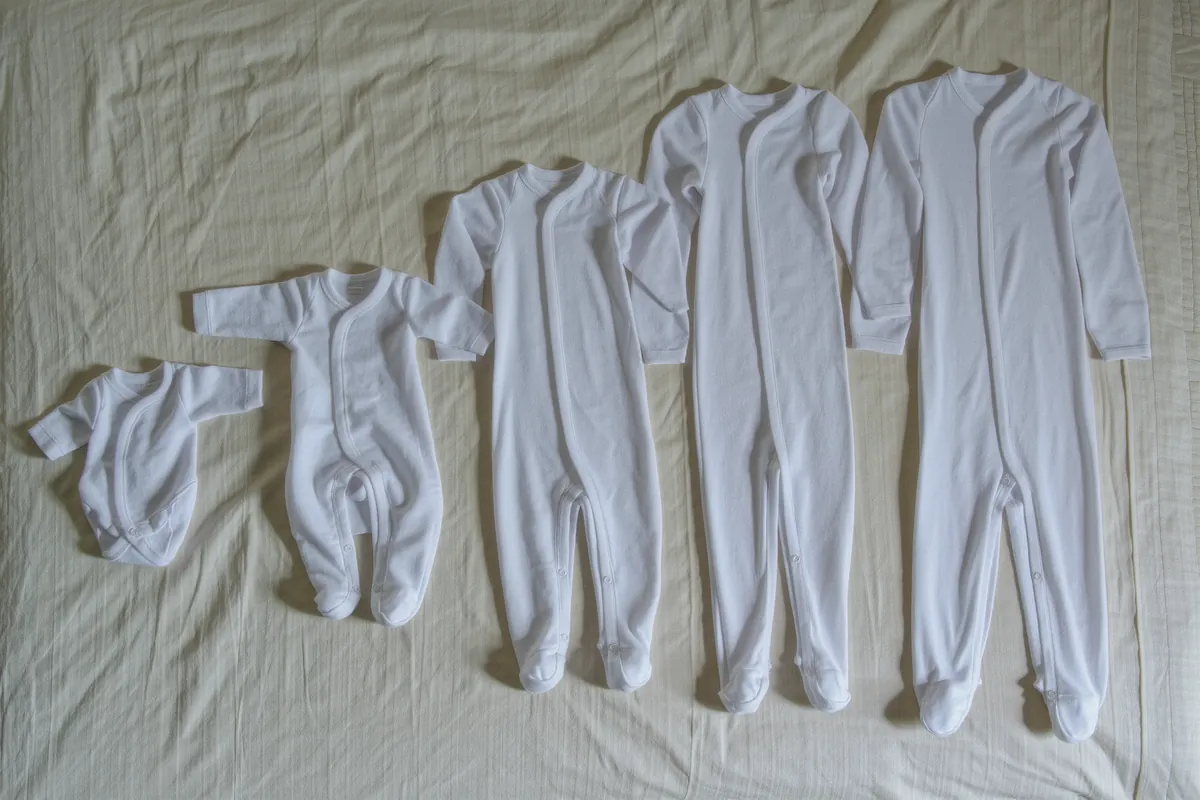
In Germany and much of continental Europe, children’s sizes are based on in centimetres. Size 56 fits a baby up to about 56 centimetres, and the sizes rise in steps of 6 centimetres: 50, 56, 62, 68, 74, 80, 86, 92, 98, 104, 110, 116, 122, 128 and so on.
The logic is pleasingly direct. You measure the child, not the calendar. The number on the label tells you roughly how tall a child the garment is cut for, so a quick measurement at home is often more useful than any conversion table.
Measuring is simple. Lay a baby on a flat, firm surface and measure from the top of the head to the heels, with the legs gently stretched. An older child can stand barefoot against a wall, heels together, while you mark the top of the head. Write the date beside the number, and you will soon see how quickly the next size comes round.
The UK, Ireland and France: sizes by age
In the UK and Ireland, and in France, children’s clothes are usually labelled by age. A British label might read 3 to 6 months or 2 to 3 years; a French one, 6 mois or 2 ans.
Age labels are friendly and easy to understand, especially for gifts. They describe the child a garment is designed for on average, however, not the height it will actually fit. Two children of the same age can need different sizes, and the label cannot know which of them will wear it.
The United States: age bands, then T sizes
US sizes use age bands for babies, starting with newborn, then 0 to 3 months and so on. Toddlers then move on to sizes 2T, 3T, 4T and 5T, where the T stands for toddler, and after that come numbered children’s sizes.
Because these sizes are based on age too, the same caution applies. An age band is an average, and children of the same age can differ noticeably in height.
How fast children grow
Growth is the reason sizes are outgrown so quickly in the early years. Babies grow fastest in the first year, about 25 centimetres. In the second year growth slows to roughly 10 to 12 centimetres, and later to around 6 centimetres a year until puberty.
The , published in 2006, give a useful sense of scale. The figures below are approximate medians, which means that half of children are taller and half are shorter.
At four years the is about 103 centimetres, and at five years about 110. Set these numbers beside the European size steps and the pattern is clear: in the first year a baby can move through four or five sizes, while an older child, growing around 6 centimetres a year, may stay in one size for most of a year.
Height before age
Age labels are averages. A tall six month old may already need size 74, so height is a more reliable guide than age. If you shop across different systems, measure your child, use the centimetre size as your anchor and read age labels as a rough translation.
You measure the child, not the calendar.
- Measure your child’s height every few months, and before any larger purchase.
- Choose the centimetre size at or just above your child’s current height.
- Treat age labels as a starting point and check the size chart that comes with the garment, where there is one.
- For footed sleepsuits, make sure the feet have room to stretch out.
Choosing sizes for gifts and seasons
For gifts, buy for the age the child will be when the season of the garment arrives, not for the current age. A winter coat given in spring should fit the child of the coming winter, not the child in front of you.
With babies this matters even more. With about 25 centimetres of growth in the first year, a summer romper in size 56, bought for a baby born in winter, will most likely no longer fit when the warm weather comes. When in doubt, choose a size up: a slightly large garment can be worn with rolled cuffs, while one that is too small cannot be worn at all.
Different countries, then, label the same idea in different ways. Centimetres measure the child, age labels describe an average, and bridge the toddler years in the United States. Keep height as your guide and the season in mind, and the numbers on any label become simple to read.
Glossary
- Body height
- The measure behind continental European sizes: size 56 fits a baby up to about 56 centimetres.
- T sizes
- US toddler sizes 2T, 3T, 4T and 5T, where the T stands for toddler, followed by numbered children’s sizes.
- WHO Child Growth Standards
- Growth reference charts published by the World Health Organization in 2006, describing how children grow from birth to five years.
- Median
- The middle value of a group: half of the children measured are above it and half below it.
Questions and answers
Do age labels and centimetre sizes match?
Only roughly. Age labels describe an average child, while centimetre sizes describe height. A tall six month old may already need size 74, for example. If you are comparing systems, measure your child and take the centimetre size as your anchor, then use the age label as a loose guide rather than a promise of fit.
Which size should I choose for a gift?
Buy for the age the child will be when the season of the garment arrives, not for the current age. Babies grow about 25 centimetres in the first year, so this makes a real difference. Ask the parents for the child’s current height if you can, and when in doubt choose a size up, since a slightly large garment can still be worn.
Why does my child stay in one size longer than before?
Because growth slows after the first year. Babies grow about 25 centimetres in their first year, roughly 10 to 12 centimetres in the second, and later around 6 centimetres a year until puberty. With European sizes rising in steps of 6 centimetres, an older child may stay in one size for most of a year.