
The playroom, a room for play, making and rest
A sunny room where children build, paint, read and laugh, and where everything still finds its way home: clear zones, low open shelves, toy rotation and the safety details that matter.
Listen to a playroom on a good afternoon and you can hear it working: blocks clattering onto the floor, a felt pen squeaking across paper, a burst of laughter from behind a wall of sofa cushions. A room like this is one of the happiest places in a family home. It also asks for a little planning, so that a bright afternoon of play is not followed every evening by a weary search for the lid of the paint box. A well-planned playroom almost looks after itself.
Play is serious work, and a happy one
Play has long been recognised as far more than a pastime. Article 31 of the UN Convention on the Rights of the Child, adopted in 1989, recognises the right of every child to rest and leisure and to engage in play and recreational activities. Giving play a place of its own at home is a small, everyday way of honouring that idea.
The thought is older still. In 1837 the German educator Friedrich Fröbel opened a play and activity institute for young children in Bad Blankenburg, and in 1840 he named it , a garden of children. He designed simple play materials he called , among them wooden blocks. Nearly two centuries later, a basket of plain wooden blocks still earns its place in almost any playroom.
Zones for building, making and rest
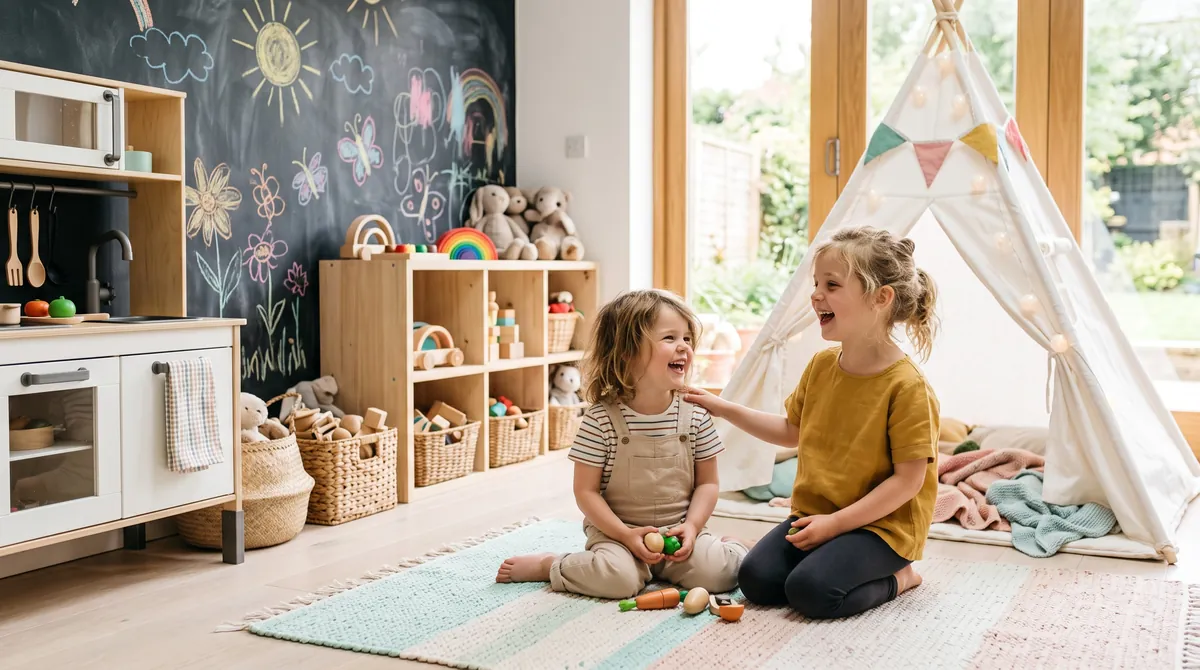
A playroom works best when it is divided into zones, even if the room itself is small. Each zone invites a different kind of play, and children quickly learn where things belong. A corner of the living room can follow the same pattern on a smaller scale.
- An open floor for building, train tracks, dens and movement, ideally on a rug that softens the sound of falling towers.
- A table for drawing and making, with chairs at the right height and a top that wipes clean.
- A soft quiet corner with cushions, a low bookshelf and good light for reading and rest.
- Storage that children can reach, so that every zone has its own shelves and baskets.
The quiet corner matters as much as the busy floor. After an hour of building and running, a nest of cushions and a favourite book can feel like the best place in the world. A room that offers both energy and rest lets a child move between them naturally, without ever being sent anywhere.
Low shelves and open baskets
Maria Montessori opened her first in Rome in 1907. Low open shelves and child-sized furniture that children can use on their own are central to Montessori environments, and they work beautifully in a playroom. When a child can see the toys and reach them, play begins without a request for help, and so does tidying up.
Open baskets, each holding one kind of thing, make order simple: blocks in one, animals in another, dressing-up clothes in a third. A small picture on the front of each basket helps children who cannot read yet. Keep the shelves generous rather than full, so that every toy has a little space around it and looks as inviting as it did on the first day.
When a child can see the toys and reach them, play begins without a request for help, and so does tidying up.
Toy rotation keeps the room fresh
Even the loveliest toys lose their sparkle when they are all on display at once. means keeping a smaller selection out and storing the rest, then swapping some of them every week or two. There is less clutter, and familiar toys feel new again when they return. A simple rhythm looks like this:
- Choose a small selection of toys for each zone and set them out on the low shelves.
- Store the rest in closed boxes or a cupboard, out of sight.
- Over the following days, notice which toys are played with and which are passed over.
- Every week or two, swap some of the quieter toys for a few from storage, and leave current favourites in place.
A returning toy is often greeted like an old friend, and the room gains a small sense of occasion each time the shelves change.
Safe, sturdy and happy to be messy
A room made for climbing, building and pretending needs a few firm rules in its construction. Tall shelves and chests of drawers should be fixed to the wall with anti-tip fittings, because furniture that tips over is a serious risk for climbing children. Low pieces with rounded edges keep the inevitable bumps gentle.
Small parts that fit into a child’s mouth are a choking hazard for children under three. In the EU, toys unsuitable for under threes carry a warning or a pictogram showing this. If older and younger siblings share the playroom, give beads and tiny construction pieces a high shelf or a lidded box that only the older child opens.
Then let the room be messy without worry. Washable rugs, wipeable paint, a table top that forgives felt pens and a floor that can be mopped mean that paint, clay and glue are welcome rather than feared. A long roll of paper across the table turns a rainy morning into a studio.
Light, colour and room to laugh
Daylight is a playroom’s best friend. Place the making table close to a window, keep the floor beside it open for sunlit building, and add warm lamps for winter afternoons. A calm base of soft walls and natural wood lets the colours of toys, books and paintings shine, and a wall of your child’s own art brings more joy than any bought print.
Above all, a playroom should feel as if it belongs to the children who use it. Ask them where the den should go and which colour the cushions should be. A room planned with care and filled with laughter will never look like a showroom, and that is exactly the point.
Glossary
- Kindergarten
- German for “children’s garden”, the name Friedrich Fröbel gave his play and activity institute for young children in 1840.
- Gifts
- Friedrich Fröbel’s name for the simple play materials he designed, among them wooden blocks.
- Casa dei Bambini
- Italian for “Children’s House”, the name of the first school Maria Montessori opened in Rome in 1907.
- Toy rotation
- Keeping a smaller selection of toys out, storing the rest and swapping some of them every week or two.
- Anti-tip fitting
- A bracket or strap that fixes tall furniture to the wall so that it cannot tip over.
Questions and answers
Do I need a separate room for a playroom?
No. The same ideas work in a corner of the living room or a child’s bedroom. Mark out a small open floor with a rug, add a low table for drawing, a few cushions with a basket of books and low open shelves your child can reach. Toy rotation matters even more in a small space, because a modest selection keeps the corner tidy and inviting.
How do I keep small parts away from a younger sibling?
Small parts that fit into a child’s mouth are a choking hazard for children under three, and in the EU, toys unsuitable for under threes carry a warning or a pictogram. Store such toys on a high shelf or in a lidded box, and let the older child use them at the table rather than on the open floor. A quick look across the floor at tidying time helps too.
How often should I rotate toys?
A common rhythm is to swap some toys every week or two, but there is no strict rule. Watch your child: when a shelf is ignored, it is time for a change, and when a toy is in daily use, it stays. Rotation is not about owning fewer things for its own sake. It keeps the room orderly and lets familiar toys feel new again.