The children’s capsule wardrobe, fewer pieces and more outfits
Ten to fifteen well-chosen pieces per season, two or three base colours and a little arithmetic: how a small, coordinated wardrobe keeps pace with a growing child.
A child’s wardrobe has a way of filling up without ever quite working. Drawers overflow, yet on a cold morning nothing seems to go with anything. A turns that around: a small, coordinated collection of around ten to fifteen pieces per season, chosen so that almost every top goes with almost every bottom. The result is fewer things, more outfits and calmer mornings.
Where the idea comes from
The term capsule wardrobe is usually credited to Susie Faux, who ran a boutique in London in the 1970s. The principle is simple: a small number of essential pieces that work together, refreshed with a few seasonal additions. In 1985 the designer Donna Karan popularised the idea with a collection called Seven Easy Pieces, a compact set of garments designed to be combined with one another.
What began as a way of organising grown-up wardrobes translates remarkably well to childhood. Children need clothes that are easy to put on, easy to wash and easy to combine. They also need them in a new size more often than most parents expect.
Why a small wardrobe suits growing children
Children grow fast, and nowhere faster than in their first two years. According to the WHO Child Growth Standards, published in 2006, the median length of a baby is about 50 cm at birth, about 75 cm at 12 months and about 87 cm at 24 months. In practical terms, a baby can need several sizes in the first year alone.
That pace changes the logic of buying. A full drawer is often outgrown before half of it has been worn. A capsule accepts that each size has a short life and makes the most of it: every piece is chosen to be worn often, and nothing waits in the cupboard for an occasion that never comes.
The arithmetic of combinations
The quiet strength of a capsule lies in multiplication. Three tops and three bottoms give nine outfits. Add two dresses or one-pieces and you have eleven. Now add two knit layers, a cardigan and a jumper, and each of those eleven outfits can be worn plain, with the cardigan or with the jumper. That is more than thirty looks from ten pieces.
This only works if the pieces genuinely belong together. A top in a colour that matches nothing else adds one outfit at best; a top that goes with all three bottoms adds three. So when you consider something new, ask how many existing pieces it works with, rather than how lovely it looks on its own.
A capsule accepts that each size has a short life and makes the most of it.
Choosing the palette and the pieces
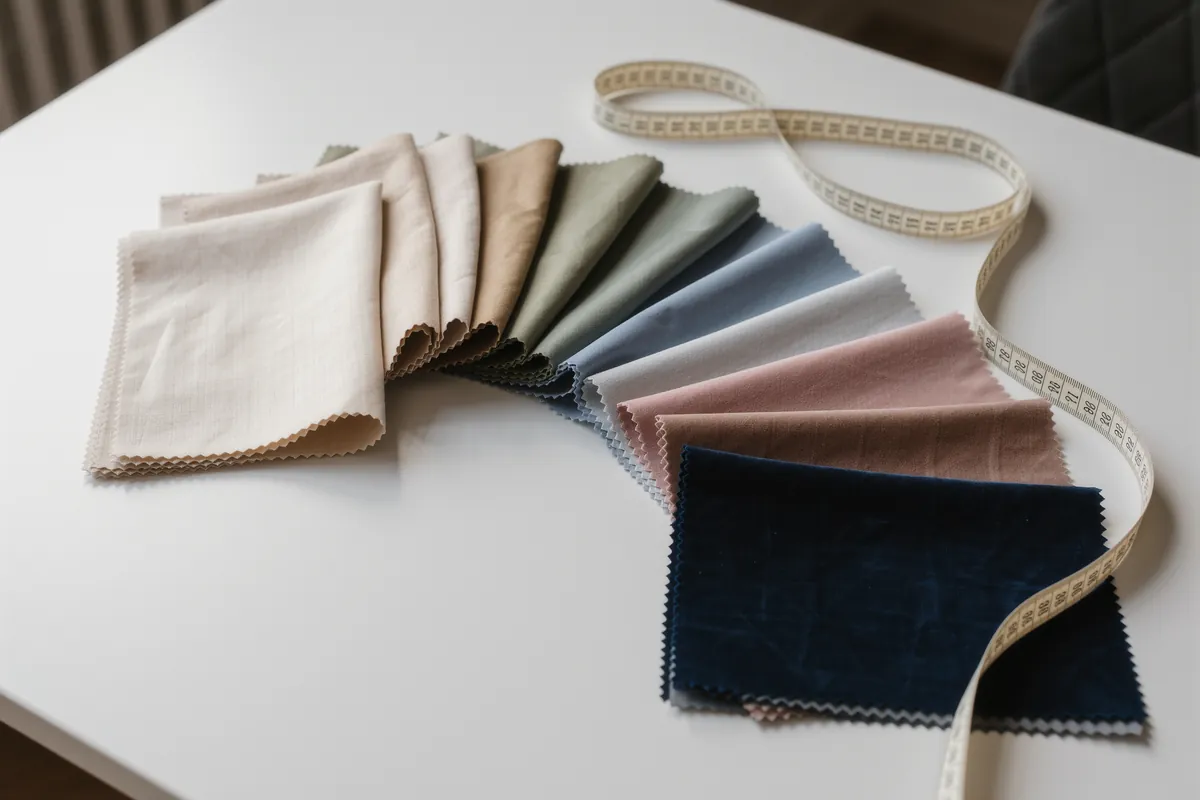
Colour is what holds a capsule together. It works best with two or three neutral base colours, for example navy, ivory, camel or grey, plus one or two accent colours. The base colours carry the trousers, skirts, coats and most of the knitwear. The accents appear in a top, a dress or a hat, and everything still matches.
For one season, a practical structure looks like this:
- Two outer layers, for example a warm coat and a lighter jacket
- Three to four tops
- Three bottoms
- One or two dresses or dungarees
- Two knit layers, such as a cardigan and a jumper
- One pair of everyday shoes and one pair for best
Counted together, that comes to thirteen to fifteen pieces: enough for real variety, few enough to keep in a single drawer and on a couple of hooks. Adjust the balance to your child’s days. A child who spends every afternoon outdoors may need an extra pair of sturdy trousers and one top fewer.
Sizes, growing room and shoes
Buying a size up is tempting, but it only makes sense for some pieces. Outerwear can be bought one size up if the sleeves can be turned back, so that the coat looks neat now and still has room later in the season. If the sleeves cannot be turned back, a coat that is too large simply gets in the way.
Shoes are the exception to every growing-room rule. They should always fit now and never be bought to grow into. If you are unsure about the fit, have your child’s feet measured before each new pair, and plan the two pairs in the capsule around the season ahead.
Keeping it going through the season
With fewer pieces, the laundry rhythm matters more. A capsule depends on clothes coming back clean and dry within a day or two, so choose fabrics that wash well and dry quickly. Cotton jersey suits tops, suits knit layers and suits trousers and dungarees.
A short monthly review keeps the system honest:
- Take out anything that has become too short in the sleeve or leg, or is worn through.
- Check which base colours and accents remain.
- Replace like with like, starting with the pieces worn most often.
- Add one new accent only if the palette has begun to feel tired.
A capsule is not a rule book. It is a way of choosing with intention, so that what your child wears is comfortable, practical and quietly beautiful, and so that getting dressed becomes one of the easier moments of the day.
Glossary
- Capsule wardrobe
- A small, coordinated collection of clothes in which almost every piece combines with the others.
- Base colour
- A neutral colour such as navy, ivory, camel or grey that carries most of the wardrobe.
- Accent colour
- A livelier colour, used sparingly, that adds interest without breaking the overall harmony.
- Cotton twill
- A sturdy cotton cloth woven with fine diagonal ribs, often used for trousers and dungarees.
- Merino
- Fine wool from the merino sheep, used for soft knitwear.
Questions and answers
How many pieces does a child’s capsule wardrobe need?
Around ten to fifteen pieces per season is a good guide. A practical structure is two outer layers, three to four tops, three bottoms, one or two dresses or dungarees, two knit layers and two pairs of shoes, one for every day and one for best. Adjust the balance to how your child actually spends the day, but keep the total small enough that every piece is worn often.
Should I buy clothes a size up so they last longer?
Only some of them. Outerwear can be bought one size up if the sleeves can be turned back, so the coat looks neat now and still has room later. Shoes are different: they should always fit now and never be bought to grow into. For most other pieces, buying the current size and replacing them as your child grows keeps the capsule working.
Does a capsule wardrobe mean more washing?
With fewer pieces, the laundry rhythm matters more, because clothes need to come back clean and dry within a day or two. Choosing fabrics that wash well and dry quickly, such as cotton jersey, merino and cotton twill, keeps the routine manageable. A smaller wardrobe can also make laundry easier to keep track of, simply because there is less of it at any one time.