
Eight classics of childrenswear and the stories behind them
From a royal sailor suit to a comic-strip shoe: where eight enduring pieces of childrenswear come from, why they lasted and how to wear them today.
Some children’s clothes simply refuse to go out of fashion. A sailor collar, a smocked bodice, a duffle coat with toggles: they appear in family photographs across generations and still look right today. Each of these classics has a story, and most of those stories begin far from the nursery, on a royal yacht, a Broadway stage, a Belgian loom or the comic pages of an American newspaper. Here are eight of them, and how to wear them now.
The sailor suit and Fair Isle: a royal influence
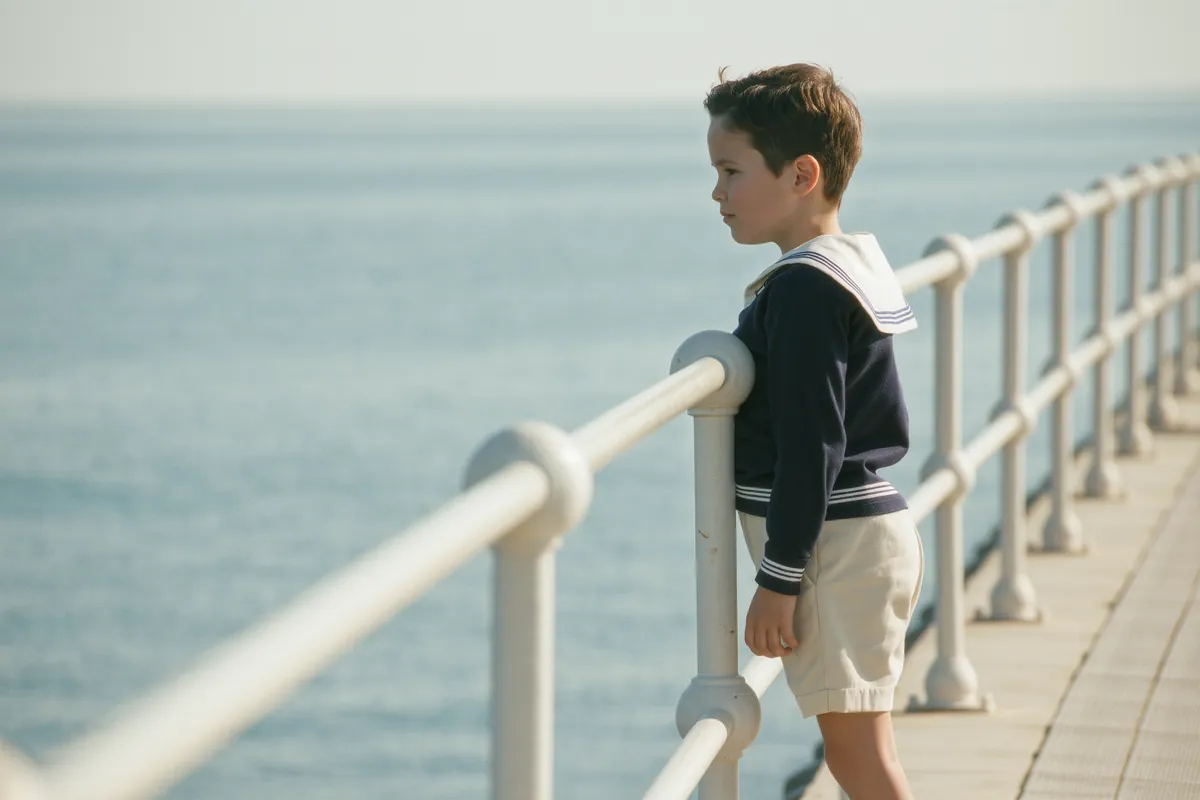
In 1846 the young Prince Albert Edward, later King Edward VII, was painted by Franz Xaver Winterhalter wearing a sailor suit made for him aboard the royal yacht. The portrait made the style fashionable for children across Europe and beyond. More than a century and a half later, sailor collars still appear on children’s clothes.
A royal wardrobe shaped knitwear too. Fair Isle knitting, a technique named after Fair Isle in the Shetland Islands, became fashionable in the 1920s when Edward, Prince of Wales, wore Fair Isle jumpers. He was the grandson of the boy in the sailor suit, which gives these two classics an unexpected family connection.
Today the two sit at opposite ends of a child’s week. A full sailor suit is an outfit for special days, while a sailor collar on a blouse or a summer dress carries the reference more lightly. Fair Isle belongs to everyday life: a patterned jumper sits naturally with plain trousers or corduroy, and a single patterned yoke on a plain cardigan is often enough.
The Peter Pan collar and smocking
The Peter Pan collar is a flat collar with rounded points. It takes its name from the costume worn by the actress Maude Adams in the 1905 Broadway production of Peter Pan. The collar has outlived that production by well over a century and remains one of the gentlest details a child’s blouse, shirt or dress can have.
is older still. It is an embroidery technique that gathers fabric into tight, even pleats held by decorative stitches. Historically it was used on the smock frocks of English rural workers in the eighteenth and nineteenth centuries. It later moved to children’s dresses for a practical reason: the gathered fabric gives room to move.
Both details still work beautifully. A Peter Pan collar looks freshest in white or ivory on a plain top or dress, where it frames the face without fuss. Smocking is at its best on light cotton, and the gathered panel keeps a summer dress comfortable through a long day of play.
Made for cold days: the duffle coat and the cardigan
The duffle coat is named after the town of Duffel in Belgium, where the thick woollen cloth was originally made. With its toggles and hood, it was widely worn by the Royal Navy in the Second World War. Afterwards it became a classic for children, and few winter coats look as composed on a child.
The cardigan is named after James Brudenell, 7th Earl of Cardigan, a British officer in the Crimean War, which lasted from 1853 to 1856. He is associated with the buttoned knitted waistcoat that carries his title. Today the cardigan is perhaps the most useful layer a child owns: easy to put on, easy to take off and right over almost anything.
Names borrowed from comics and cloth: Mary Janes and dungarees
Mary Jane shoes are low shoes with a strap across the . They are named after the character Mary Jane in the Buster Brown comic strip by Richard F. Outcault, which began in 1902. In 1904 the Brown Shoe Company licensed the characters, and the name of a comic-strip character became the name of a shoe.
The strap across the instep is what has kept the shape in use: it holds the shoe in place on a moving foot. Mary Janes are worn for occasions and for every day, in polished leather for best and in softer materials for play.
Dungarees travelled even further. The word comes from dungri, a coarse cotton cloth associated with a village near Bombay, today Mumbai. Sturdy cloth, a bib and straps: dungarees began as hard-wearing clothes, and they still suit children who kneel, climb and dig.
Wearing the classics today
The risk with classics is that they can look like a costume. The simplest safeguard is restraint: one classic piece per outfit, worn with simple, modern basics. A Fair Isle jumper with plain trousers, a Peter Pan collar under a navy jumper or Mary Janes with simple socks all look natural, because nothing else in the outfit competes.
The simplest safeguard is restraint: one classic piece per outfit, worn with simple, modern basics.
- Wear one classic piece at a time and keep the rest of the outfit plain.
- Choose calm colours, so that the detail, not the colour, catches the eye.
- Let the child move: many of these pieces are practical at heart.
- Save the full sailor suit for occasions, and let a sailor collar carry the idea on ordinary days.
Above all, choose quality over quantity. A well-made classic can be handed down, and every child who wears it adds a chapter to a story that began long before them.
Glossary
- Smocking
- Embroidery that gathers fabric into tight, even pleats held in place by decorative stitches.
- Stranded colourwork
- Knitting with more than one colour in a row, the colour not in use carried along the back as a loose strand.
- Toggle
- An elongated button, often of wood or horn, passed through a loop of cord or leather.
- Instep
- The arched upper part of the foot between the toes and the ankle.
Questions and answers
How can children wear classics without looking like they are in costume?
Keep to one classic piece per outfit and pair it with simple, modern basics in calm colours. A Fair Isle jumper with plain trousers or a Peter Pan collar under a navy jumper looks natural, while several classics at once can tip into fancy dress. Save the full sailor suit for occasions and let a sailor collar carry the idea on ordinary days.
Why are so many children’s classics named after people and places?
Many of these pieces became known through a famous wearer, a story or a place. The cardigan carries the title of the 7th Earl of Cardigan, the Mary Jane shoe a comic-strip character and the Peter Pan collar a stage costume, while the duffle coat and Fair Isle knitting are named after places. The names have stayed even where the stories are half forgotten.
Is smocking only decorative?
No. Smocking gathers fabric into tight, even pleats held by decorative stitches, so it is both ornament and structure. It was used on the smock frocks of English rural workers in the eighteenth and nineteenth centuries and later moved to children’s dresses because the gathered fabric gives room to move. That mix of beauty and practicality explains why it has lasted.